Why Your Bra Might Be Making You Anxious (It's Not in Your Head)
Updated: Jul 27
The surprising connection between that tight band and your stress levels.

"I had to compromise breathing. I had to compromise comfort. I had to compromise my posture. I had to compromise even... the scars... the welts... the grooves."
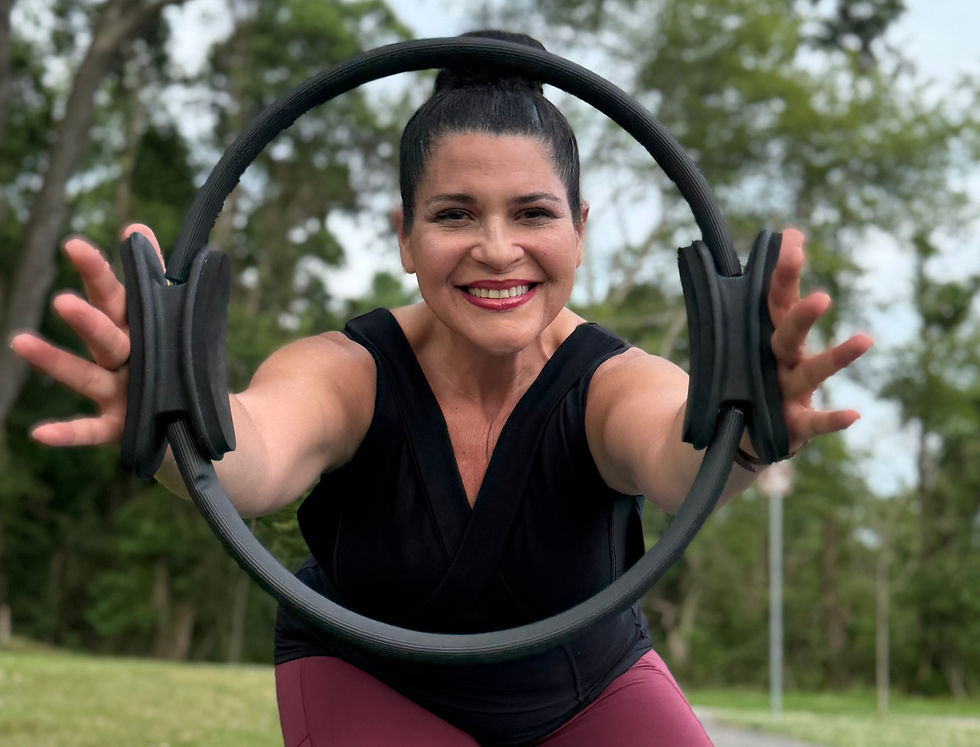
When Pilates instructor Marjorie listed out everything she's given up just to wear a sports bra and feel supported while working out, she said it like it was normal. It's just what is expected of fuller-busted women who want to be active.
Most of us have been compromising in the same ways for so long that we've stopped noticing. Strapping on the tight chest band, feeling it cut into our ribs, adjusting to the shallower breathing. It's a given. These compromises are part of the constant low-grade discomfort we push to the back of our minds because we have things to do.
That discomfort isn't just a superficial, inconvenient physical sensation. It affects your nervous system in ways that can contribute to anxiety, and you might not even know it's happening.
The Compromise Nobody Talks About
Every day, millions of women strap on a bra and begin a series of micro-compromises:
You take shallower breaths because deep ones feel restricted. You adjust your posture to accommodate the dig of the straps. You ignore the tightness around your ribcage because you've been ignoring it for decades.
"I couldn't breathe," Marjorie said during our conversation on Off Your Chest. "All these outfits that promised support and beauty and comfort....didn't let me breathe. I had to just simply compromise and adjust: okay, it's going to be uncomfortable for an hour, for two, and I'm going to come back home and take it off."
Sound familiar?
We've been taught that this is the price of looking "put together." If we dare to say a bra feels too tight, we're corrected and told that our discomfort is because we're wearing the wrong size. What feels "tight" to us is dismissed as correctly "snug". We're told that's how good support is supposed to feel.
But your body knows something your mind has learned to ignore.
How Chest Constriction Triggers Your Stress Response
Your body has an internal sensing system called interoception. It's how your brain monitors what's happening inside: your heartbeat, your hunger, your breath. It's constantly asking, Am I safe?
When something constricts your ribcage—like a tight bra band—your body notices. It doesn't interpret that sensation as "fashion choice." It interprets it as threat.
A study published in the International Journal of Biometeorology found that wearing tight clothing significantly increased levels of cortisol, adrenaline, and noradrenaline—the same stress hormones that flood your system when you're in danger.
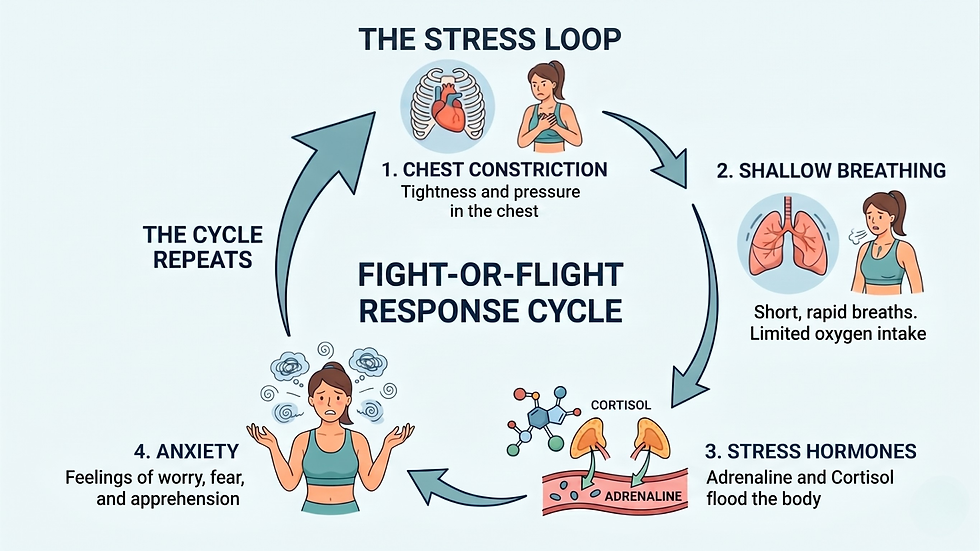
Your brain doesn't distinguish between a tight bra and a physical threat. It just knows: Something is squeezing me. Something is restricting my breath. I need to be on alert.
This triggers your sympathetic nervous system—the "fight or flight" response. Your heart rate increases. Your breathing becomes more shallow. Your body shifts into low-grade survival mode.
And because shallow breathing is both a symptom of anxiety and a trigger for it, you get trapped in a feedback loop:
The tight band restricts your breath → restricted breath signals danger → your brain releases stress hormones → you feel more anxious → you breathe even more shallowly.
This cycle continues all day. Every day you wear that bra.
Why Taking Off Your Bra Feels So Good

Ever wonder why removing your bra at the end of the day feels like such profound relief?
It's not just physical. Your entire nervous system is shifting gears.
The moment you remove that constriction, your parasympathetic nervous system (the "rest and digest" response) finally takes over. According to Harvard Health, this system acts like "brake," counteracting the revved up energy of the stress response, and calming your body down after a perceived threat has passed.
Finally, your diaphragm can move freely. Your ribs can expand. Oxygen floods into the lower portions of your lungs that have been restricted all day. And all the other systems of your body can start working naturally again.
That full-body relaxation is your body finally getting the signal: "You're safe now."
That's precisely why Embrago created the patented bandless bra-free support system that eliminates the chest constriction of typical sports bras.
Marjorie described the feeling of that non-constrictive bust support perfectly: "It gave me so much support, especially from the back to the front, that I immediately felt, I don't need a bra. How liberating is that?"
"Breathing Is Exercise Number One"
As a Pilates instructor, Marjorie understands something most of us have forgotten: breathing is foundational to good health.
"If you don't support your breathing, you can't expand and grow your core," she explained. "Your design allows you to breathe and expand your back without feeling that restriction. Without feeling that you're going to explode if you take the fullest deep breath."
In Pilates—and in life—the quality of your breath determines everything. Deep, diaphragmatic breathing activates the vagus nerve, which helps regulate your parasympathetic nervous system. It tells your body to relax, digest, and heal.
But if your ribcage can't expand fully, none of that happens. You stay stuck in low-grade fight-or-flight, burning through energy and wondering why you feel so depleted by evening.
Research from the VA's Whole Health Library confirms that "shallow breathing often accompanies stress, anxiety, and other psychological difficulties" and that diaphragmatic breathing can reverse the fight-or-flight response.
Your bra may literally be preventing your body from activating its built-in calm-down system.
Where It Starts
For many of us, the compromise began before we had words for it.
Marjorie remembers the exact moment. She was in her early twenties, getting dressed, feeling young and beautiful. Her mother looked at her and said: "I like everything, but what are you going to do with that?" (gesturing at her chest).
"That's when I started looking for support to hide, to contain, to make them smaller," Marjorie said. "I wasn't necessarily feeling the proudest, but I had a task. My job was now to find that piece of clothing that was going to make me look less."
This is where it begins for so many women: a comment or a look that stays with us for life. It's a rude awakening to the reality that our bodies are seen as a problem to be managed.
We get drawn into the "pain equals beauty" contract—except nobody tells us about the pain part. We internalize the message and normalize it, understanding implicitly that our own feelings are irrelevant. This is the price of entry to womanhood.
Why the Fashion Industry Never Fixed This
If tight bras and visibly larger chests cause so many problems, why hasn't someone designed better clothing?
That's exactly what I wondered when I started researching. I didn't expect what I learned next.
In an interview I found, a fashion industry veteran was asked: Why aren't there more high-quality clothing options for fuller-busted women?
The answer: "Because large breasts never say wealth or class."
I gasped out loud at the shameless bias in that statement.
Fashion (especially luxury fashion) has historically catered to thin body ideals associated with status, discipline, and control, while fuller busts have often been coded as excessive, vulgar, or “unrefined.”
Instead of solving the problem, the fashion industry ignored us, communicating that our bodies don't deserve beautiful design or premium fabrics.
Meanwhile, they blame it on our ignorance. They say we simply need to be educated how to find the "right" fit. As if we couldn't judge that for ourselves.
Here are the unspoken realities:
In mainstream fashion, mass production favors the simplified sizing and cheaper construction that prioritizes profit over fit. Straighter bodies mean straighter lines, which are easier and require less labor to cut and sew, so they can get away with mediocre design and cheaper fabric.
In premium and luxury fashion, designing for fuller busts has simply been deprioritized in favor of maintaining an exclusionary standard. Body positivity gets lip service, but it hasn't resulted in industry change.
Holding vs. Supporting
During our conversation, Marjorie shared something fascinating and telling, from a linguistic standpoint:
"Do you know what the word in Spanish is for bra?" she asked. "It's sostén. And sostén means to hold. It's a holder."
It's a holder, not a supporter.
Think about the difference. A holder traps and constrains, keeping things in place by force. But good support embraces in an uplifting and empowering way that works with your body's curves instead of against them, lifting without squeezing.

Typical bras really are just holders. They use tight elastic bands and compress breast tissue into submission. They fight gravity through force—and your body pays the price.
Good support shouldn't require constriction.
What Real Support Feels Like
When Marjorie first tried Embrago, she didn't believe it would work. She'd been promised "support and comfort" before by so many "comfort bras" and bra alternatives that never delivered.
"I didn't believe you--until I tried it on," she said. "It gave me so much support, especially from the back to the front, that I immediately felt, "I don't need a bra! This is the bra and the top. This is a blouse. This is a dress."
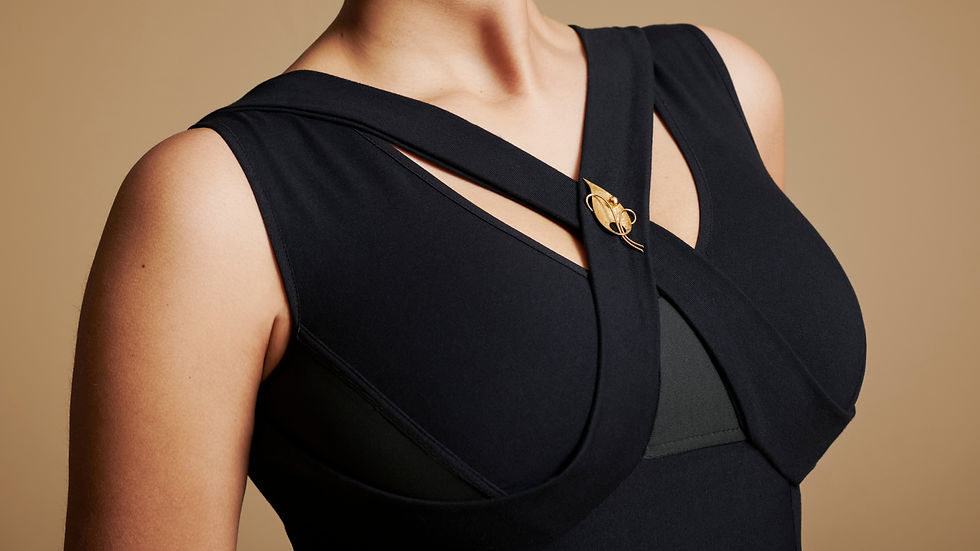
What makes it different?
No tight band around the ribcage. No horizontal constriction. No digging shoulder straps. Instead, Embrago uses a "floating" system that supports using the the whole torso, shoulders and back—distributing weight evenly instead of compressing the chest.
"The freedom to walk, to sit, to breathe," Marjorie said. "To eat a meal without feeling squeezed. To look beautiful and supported."
Listen to Your Body
You are not being dramatic when you rip off your bra at the end of the day.
You are not being weak when you say it's too tight.
You are not being unreasonable when you want to breathe freely.
Your body has been sending you signals: discomfort, irritation, shallow breathing. Even that low-grade anxiety you never guessed was connected to your physiology. Those signals are very real and they're telling you something important.
You already know intuitively that a tight band around your chest just feels wrong. By signalling discomfort, your body is doing exactly what it's designed to do. It's asking for safety. You have options.
Watch the Full Conversation
This post was inspired by the first episode of Off Your Chest, featuring honest conversations about style, support, and self-trust.
In this episode, Marjorie and I go deeper into her 30-year journey with sports bras, the moment that changed how she saw her body, and what she discovered when she found support that actually worked.
Plus, she teaches a beginner-friendly Pilates breathing routine you can do at home.
Ready to Feel the Difference?

If you've been compromising your breath, your comfort, and your peace of mind just to look "put together," there's a better way.
Embrago's patented Body Responsive Design™ provides full bust support without constriction—no tight bands, no underwires, no compression. Just support that moves with your body and lets you breathe.
Looking for guidance on what style would work best for you? See our guide to yoga tops for fuller busts.
Free shipping and a 30-day risk-free guarantee. Say goodbye to bra-induced stress for good.
Sources:
Mori Y, Kioka E, Tokura H. "Effects of pressure on the skin exerted by clothing on responses of urinary catecholamines and cortisol, heart rate and nocturnal urinary melatonin in humans." International Journal of Biometeorology, 2002;47(1):1-5.
Harvard Health Publishing. "Understanding the Stress Response." Harvard Medical School, 2024.
VA Whole Health Library. "The Power of Breath: Diaphragmatic Breathing." U.S. Department of Veterans Affairs.